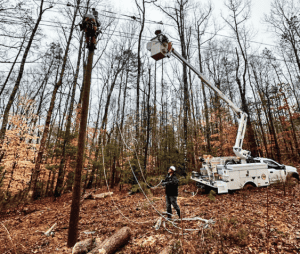
A well maintained right-of-way allows Little River crews to access lines and restore power to members more easily. Here a crew works to repair lines after a tree fell due to recent heavy rains.
Members depend on Little River Electric to deliver safe, reliable power to their homes and businesses. An important part of meeting that responsibility is regularly trimming trees in our rights-of-way. You might not realize it, but there are several benefits to regular tree trimming.
Reliability
Keeping power lines clear of overgrown vegetation improves service reliability.
“We’ve seen what Mother Nature can do during severe weather events with fallen tree limbs taking down power lines and utility poles,” says Steven Hughes, manager of right-of-way. “There is a lot that can impact power disruptions, but overgrown vegetation is responsible for many outages.”
That’s why you sometimes see Little River crews or contractors out in the community trimming trees near power lines. Trimming crews have been trained and certified based on the latest industry standards.
In fact, electric utilities are required to trim trees that grow too close to power lines. Scheduled trimming throughout the year keeps lines clear from overgrown or dead limbs that are likely to fall so that Little River Electric is better able to prepare for severe weather events.
It’s also more cost-effective to undertake preventative maintenance than it is to make repairs after the fact.
Safety
Working near power lines can be dangerous, and we care about your safety and that of Little River lineworkers. For example, if trees are touching power lines in our members’ yards, they can pose a grave danger to families.
“If children can reach those trees, they can potentially climb into a danger zone,” says Hughes. “Electricity can arc, or jump, from a power line to a nearby conductor such as a tree.”
Any tree or branch that falls across a power line creates a potentially dangerous situation. A proactive approach lessens the chances of fallen trees during severe weather events that make it more complicated and dangerous for lineworkers to restore power.
Affordability
Little River always tries to keep costs down for our members. If trees and other vegetation are left unchecked, they can become overgrown and expensive to correct. A strategic vegetation management program helps keep costs down for everyone.
“We have deep roots in our community, and we love our beautiful surroundings,” says Hughes. “It takes a balanced approach, and our vegetation management program is a crucial tool in ensuring service reliability.”
You can help
There are ways you can help too. When planting new trees, make sure they’re planted a safe distance from overhead power lines.
- Medium-height trees (40 feet or smaller) should be planted at least 25 feet from power lines.
- Taller trees (over 40 feet) should be planted at least 50 feet from power lines.
- When planting near pad-mounted transformers, plant shrubs at least 10 feet from the transformer door and 4 feet from the sides.
- Remember to contact 811 before you begin any project that requires digging.
- If you spot an overgrown tree or branch that’s dangerously close to overhead lines, please let us know by contacting (864) 366-2141.
